Home

We actively collaborate with our colleagues in the University of Iowa Institute for Vision Research in the study of blinding diseases including Bardet-Biedl syndrome, Best disease, Stargardt disease, Leber congenital amaurosis, retinitis pigmentosa, choroideremia, glaucoma, and other acquired and inherited diseases of the retina.

Our laboratory employs a multidisciplinary approach involving donated human eyes, cell culture models including induced pluripotent stem cells, mouse models, and anatomical, molecular, and functional studies. It is our goal to use this knowledge to improve treatments and ultimately develop cures for the millions of individuals whose sight is threatened by retinal and choroidal diseases.
Recent News

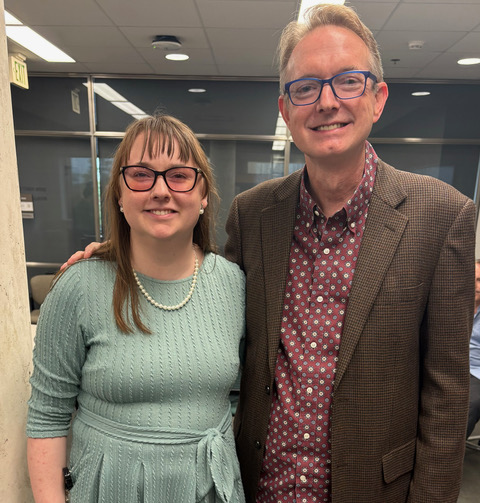
  • Emma Navratil and Rob Mullins
    Wed, 11/04/2026

    The lab would like to congratulate Dr. Emma M. Navratil for successfully defending her dissertation, "Metabolism and Glycosylation in the Aging Human Choroid: Relationship to Macular Degeneration and Genetics”. Emma (left) is pictured here with her mentor Dr. Mullins (right).

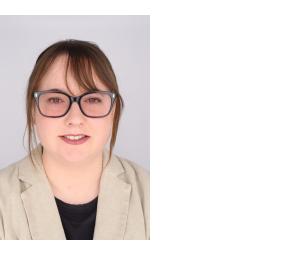
  • Emma Navratil Individual Photo
    Wed, 04/08/2026

    The laboratory would like to congratulate Emma Navratil on being selected to receive the Ballard Seashore Dissertation Fellowship from the University of Iowa!

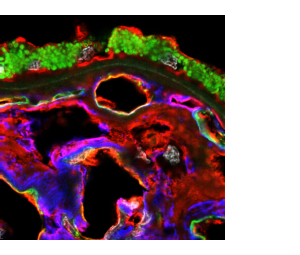
  • Human Choroid labeled with EBL (a-2,6 sialic acid) in red, anti-CD34 (endothelial cells) in green, anti-Collagen IV (endothelial basement membrane) in blue, and DAPI (nuclei) in white.
    Tue, 09/02/2025

    In a recent paper by Navratil et al, we examined the distribution and partial identities of sialic acids in human choroid, retinal pigment epithelium, photoreceptors, and lesions of age-related macular degeneration (AMD) using lectin histochemistry and microscopy.